
Most first-time importers approach this backwards. They open a supplier’s catalogue, pick the model that looks best, then discover three weeks later that the vehicle does not clear customs in their country, or that the container only fits half of what they assumed.
The sequence below is the one that avoids those two failures. It is written for distributors, rental operators and fleet buyers ordering their first or second container — not for someone who already runs a monthly programme.
Table of Contents
- 1. Start with your road, not the catalogue
- 2. Settle the certification question before you discuss price
- 3. Three specifications that actually drive the price
- 4. SKD or CKD decides your freight bill
- 5. Payment terms and what “factory direct” should mean
- 6. The HS code is not one number
- 7. Spare parts are part of the purchase, not an afterthought
- Frequently asked questions
- What to do next
The single biggest cause of a bad first order is specifying for the catalogue photo instead of the actual route.
Four things decide the specification before you look at any model:
| Question | Why it changes the vehicle |
|---|---|
| What is the steepest grade on the route? | A 400 kg load on a 25° incline needs a different motor and controller than the same load on flat ground |
| What surface — sealed, dirt, sand, mud? | Tyre type, ground clearance and body sealing all follow from this |
| How long is a typical daily run? | Directly sets battery capacity, and therefore most of the unit price |
| Where will it be charged? | If charging is unreliable, lead-acid with a removable pack often beats lithium on total cost |
In practice, buyers in West and East Africa usually specify for mixed sealed and dirt roads with long daily distances. Buyers in Southeast Asian cities specify for narrow streets and short high-frequency trips. Those two briefs produce genuinely different vehicles, even from the same factory.
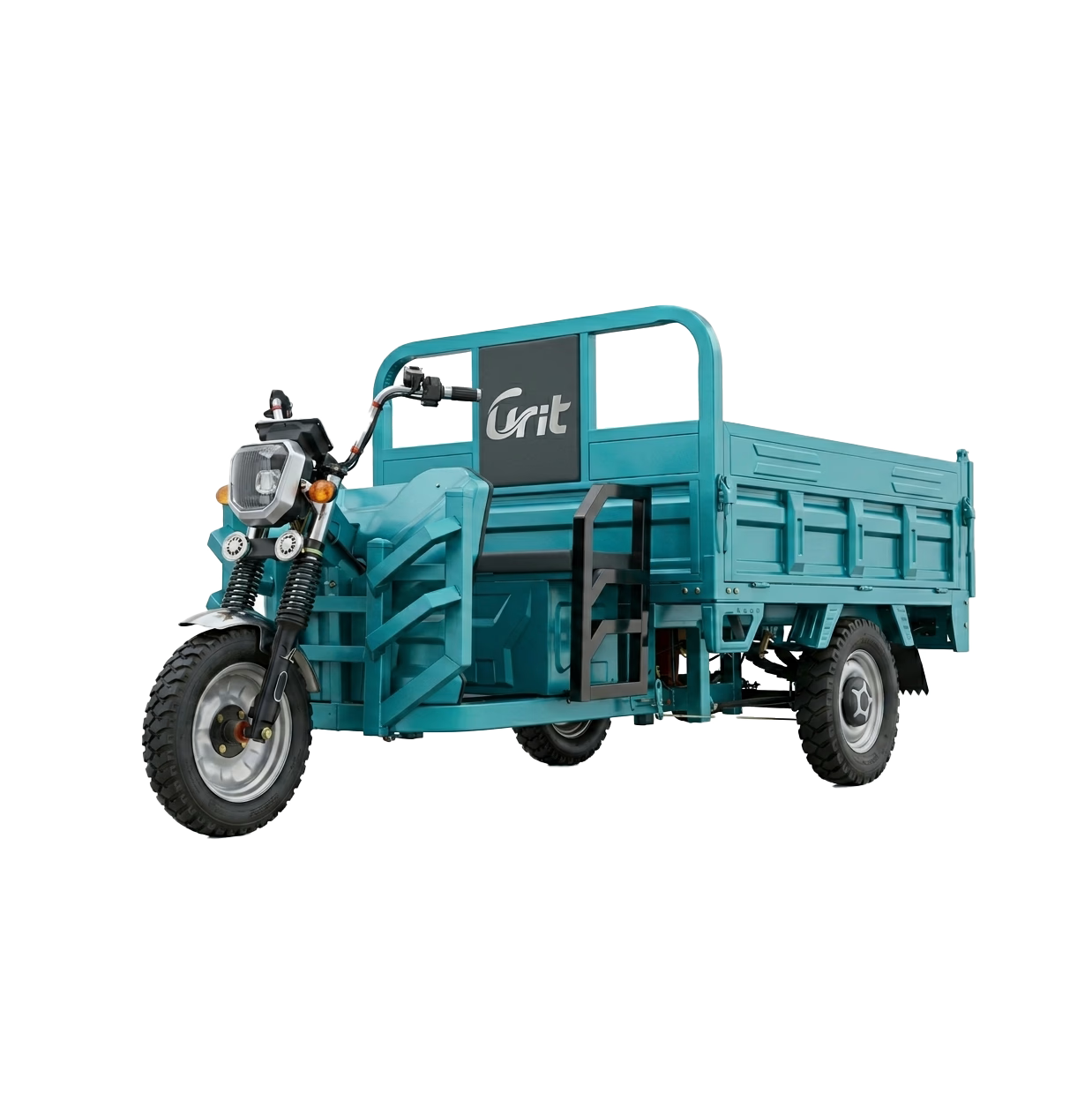
If payload is the deciding factor for you, our cargo tricycle range is built around that — 400 kg, 800 kg and 1-ton bodies on the same three-wheel platform.
2. Settle the certification question before you discuss price
This is where most first orders stall, and it is entirely avoidable.
What your market actually requires falls into three rough groups:
- EU / EEA: road-registered vehicles need type approval, not just a CE mark. A CE certificate on the vehicle is often not sufficient for registration, and the importer is the one who discovers this at the port.
- Most of Africa, Middle East, South Asia: requirements vary from full homologation to a simple commercial invoice and inspection certificate. Some markets accept CE documentation as supporting evidence; others have their own scheme.
- Off-road and private-site use: certification requirements are usually lighter, because the vehicle never registers for road use.
Two things worth doing before you pay a deposit:
- Ask your customs broker what document they need to clear an electric three-wheeler. Get it in writing.
- Ask the factory which specific models hold which certificates — not whether the factory “has CE”.
We provide CE and EEC documentation for the models that support it, and we will tell you upfront if a particular model does not carry the certificate your market needs. That conversation is cheaper before the deposit than after.
3. Three specifications that actually drive the price
Most of the price difference between two quotes for “the same” tricycle sits in three places:
Battery capacity and chemistry. A 60V lead-acid pack and a 60V lithium pack of nominally similar range differ substantially in price, weight and service life. Lead-acid is typically replaced every 2–3 years; lithium is commonly quoted at 5 years or more. On a rental fleet, the second purchase usually decides which was cheaper.
Motor and controller rating. A 1,000W motor and a 2,000W motor are not interchangeable on hilly routes. Under-specifying the motor to save money produces a vehicle that cannot complete its route loaded — the most expensive outcome of all.
Body and sealing. An open bed, a canopy and a fully enclosed cabin are three different vehicles in cost and in use. For parcel delivery in a rainy season, the enclosed body pays for itself; for construction haulage, it is wasted money.
A useful reference point: the U3 three-wheel cargo tricycle carries 400 kg on a 60V platform and is the model most first-time importers start with, while the G011 long-range cargo tricycle trades some payload for a 70 km working range.
4. SKD or CKD decides your freight bill
This is the decision that most affects your landed cost, and most buyers do not ask about it until the quote stage.
| Shipping form | What arrives | Typical 40HQ loading (400 kg cargo model) |
|---|---|---|
| SKD (semi-knocked down) | Mostly assembled, wheels and some parts loose | 36 units |
| CKD (completely knocked down) | Flat-packed components, assembly required | 65 units |
CKD nearly doubles the units per container, but you take on local assembly labour, and some markets charge a different duty rate on unassembled components than on complete vehicles. SKD is faster to market and needs less skilled labour. Neither is universally better — it depends on whether you have an assembly capability and what your tariff schedule says.
For passenger models the numbers are lower: a 9-seat tuk tuk loads around 25 units SKD or 48 CKD per 40HQ.
5. Payment terms and what “factory direct” should mean
Standard terms in this industry are a deposit with the balance against the bill of lading, typically 30/70. Be cautious with anyone asking for the full amount upfront on a first order.
“Factory direct” is worth verifying rather than assuming. Two questions separate a manufacturer from a trading company:
- Can they show you the assembly line, or only a showroom?
- Can they change the specification — motor, battery, body, colour — or only sell what is in stock?
A trading company is not automatically a bad partner, but you should be paying trading-company margins knowingly.
6. The HS code is not one number
Electric three-wheelers do not sit under a single harmonised code. Depending on the vehicle’s structure, construction and intended use, classification commonly lands in one of the goods-vehicle, passenger-vehicle or motorcycle headings.
Do not take a code from a supplier’s invoice as final. Send the vehicle specification — including whether it is designed to carry goods or passengers — to your customs broker and let them pre-classify. Getting this wrong produces either an overpayment or a customs query that holds the container for weeks.
7. Spare parts are part of the purchase, not an afterthought
A container of vehicles without spare parts is a fleet that stops the first time a brake pad wears out.
For a first order, budget for a spares allowance covering the consumables: tyres, tubes, brake shoes, controllers, chargers and one spare battery pack. On our standard terms we quote a consumables allowance alongside the units so the first-year cost is visible before you commit.
Ask for the parts list — not a promise of support, but an actual list with part numbers. If a supplier cannot produce one, parts availability after the sale is a guess.
Frequently asked questions
What is the minimum order? One unit. We quote single units for evaluation and small orders, though freight per unit drops sharply once you fill a container.
How many fit in a 40HQ? For a 400 kg cargo tricycle: 36 units SKD or 65 CKD. Tuk tuks: roughly 25 SKD or 48 CKD. Golf carts: 35 SKD or 50 CKD.
Are the batteries safe to ship? Lithium packs require UN38.3 test documentation and are shipped under specific dangerous-goods rules. Lead-acid is simpler. Confirm with your freight forwarder which documentation they need before booking.
What warranty comes with the vehicle? Twelve months as standard. Ask what the warranty covers — frame, motor, controller and battery are usually treated differently.
What to do next
If you are at the specification stage, the most useful thing you can do is write down your route, payload, daily distance and charging situation, then send it over. We will tell you which of our models fits, and — more usefully — which ones do not.
Browse the electric cargo tricycle range or the passenger tuk tuk range, or send us your route details and we will come back with a specification and a factory quote.