
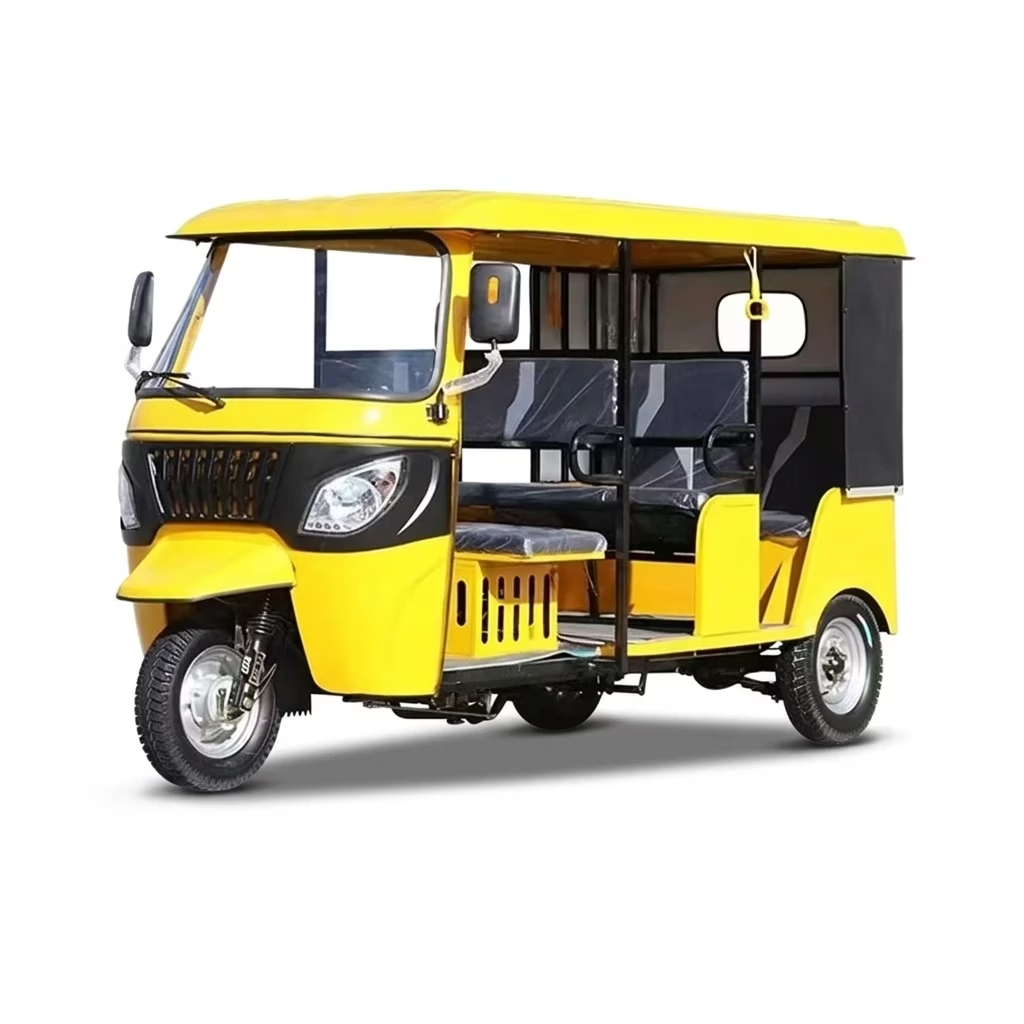
Both are three-wheeled electric vehicles built in the same factories, often on similar chassis. Buyers regularly ask us to quote “a tricycle” and then discover halfway through the conversation that they needed the other one.
The difference is not cosmetic. It changes what you can legally register, how the vehicle earns money, and how fast it pays for itself.
The short answer
| Electric cargo tricycle | Tuk tuk (passenger tricycle) | |
|---|---|---|
| Primary job | Move goods | Move people |
| Typical payload / capacity | 400 kg – 1 ton cargo bed | 4, 6 or 9 passengers |
| Body | Open bed, flatbed, tipper, lockable box | Bench seats, canopy or enclosed cabin |
| Vehicle class in most markets | Goods vehicle | Passenger vehicle |
| Revenue model | Per trip, per ton, per day hire | Per passenger, per route, per shift |
| Best fit | Last-mile parcel, retail replenishment, construction, farm produce | Taxi, tourism shuttle, airport transfer, staff transport |
If you are still at the stage of choosing a business model, that table is most of the answer. The rest of this article covers the parts that table cannot show.
1. Payload and body: the constraint is not the number, it is the shape
A 400 kg cargo tricycle and a 6-seat tuk tuk may have similar gross weight ratings, but they are not interchangeable because the load sits differently.
Cargo bodies are built around access: a tipper for bulk material, a flatbed for oversized items, a lockable box for parcels that must not walk away. The cargo tricycle range is specified around that — 400 kg for parcel and market delivery, 800 kg for building materials and farm produce, 1-ton bodies for industrial and municipal haulage.
Passenger bodies are built around boarding and comfort. Seat spacing, step height, grab handles and canopy coverage matter more than cargo access. A 6-seat passenger tricycle and a 9-seat enclosed model serve different routes: the 6-seat suits short urban hops with frequent boarding, the 9-seat suits longer shuttle runs where the vehicle stays loaded.
One practical note: buyers often over-specify seats. Every extra seat is weight and space taken from luggage, and in many markets the licensing category changes between a 6-seat and a 9-seat passenger vehicle.
2. Route type decides more than the vehicle type
Two questions sort most buyers faster than any specification sheet:
Is the route fixed and repeated, or variable? A tuk tuk on a fixed shuttle route is highly efficient — same distance, same load pattern, predictable charging window. A cargo tricycle on variable delivery routes faces unpredictable loads and gradients, which argues for a larger motor and a bigger battery than the route distance alone would suggest.
Is the vehicle loaded most of the day, or mostly empty? Passenger vehicles spend much of their time partially loaded, which is fine. Cargo vehicles are usually either full or empty. A cargo tricycle working at maximum payload on gradients needs motor headroom that a passenger vehicle rarely does.
For reference, the U3 three-wheel cargo tricycle is rated for 400 kg on a 60V platform and is the model most importers start with for urban delivery — it is deliberately sized for full-load city work rather than occasional heavy haulage.
3. Regulation: goods vehicle or passenger vehicle
This is the difference that catches importers, and it is decided before the vehicle arrives.
In most jurisdictions, a passenger-carrying three-wheeler and a goods-carrying three-wheeler fall under different registration categories. That cascades into:
- Licensing — passenger service often needs an operator permit and a driver with a passenger-carrying licence; goods vehicles usually need a different class
- Insurance — passenger liability cover is priced differently from goods-in-transit cover
- Inspection — passenger vehicles typically face stricter periodic inspection
- Import duty — some tariff schedules classify passenger and goods three-wheelers under different headings
Before you order, ask your local authority which category your intended use falls into, then tell us. We will confirm which body and seating configuration matches that category. A vehicle that cannot be registered is not a bargain at any price.
4. Revenue model and payback
The two vehicles earn money differently, and that usually decides the order.
Tuk tuk: high frequency, low ticket. Revenue comes from many short trips. The constraint is driver hours and vehicle uptime — a tuk tuk off the road for repairs loses a full day of fares. Charging time matters more than range.
Cargo tricycle: lower frequency, higher ticket. Revenue comes from contracted deliveries or day hire. The constraint is payload and reliability under load — a cargo tricycle that cannot complete a full route loaded loses the contract, not just a trip.
This is why fleet buyers in tourism markets order tuk tuks in batches of ten and cargo operators order three or four at a time. The unit economics of each model reward different things.
5. Can one vehicle do both?
Technically yes — removable bench seats turn a cargo bed into a passenger body in about twenty minutes. Commercially, it rarely works.
The registration category usually locks the vehicle to one use. Switching between passenger and goods operation may require re-registration, and the vehicle is optimised for neither: a compromise body carries less cargo and seats fewer passengers than a dedicated one.
Where conversion does work is on seasonal routes — a resort that carries guests in high season and supplies in low season, on private land where road registration does not apply. Outside that case, buy the vehicle for the job.
6. If you are starting small
A common first order for a new operator is two vehicles, not one. One vehicle means any breakdown stops the business entirely; two gives you a spare and a comparison point for maintenance costs.
Our minimum order is one unit, and we quote single units for evaluation. But if you are building a business rather than testing a supplier, two is the sensible starting point — and the freight per unit drops once you are filling container space.
Frequently asked questions
Which is cheaper to buy? For comparable battery capacity and build quality, a cargo tricycle and a passenger tuk tuk are in a similar price band. The passenger version usually costs more once you add seating, canopy and doors.
Which has lower running costs? Running costs are close — same drivetrain technology, similar weight. The difference is in consumables: passenger vehicles wear brakes and tyres faster in stop-start work, cargo vehicles wear them faster under load.
Can a cargo tricycle carry passengers legally? In most markets, no — not for hire or reward. Passenger operation requires a passenger-class vehicle and licence. Check locally before assuming.
Next step
Tell us the route, the load and how the vehicle will earn money. Those three answers usually settle the choice in one conversation.
Browse the electric cargo tricycle range or the passenger tuk tuk range, or send us your route details and we will confirm which body and seating configuration fits.