
Description
Four seats on an electric golf cart is not a smaller version of six. It is a different job: fewer players per trip, more room for bags, and a body that turns on a narrow cart path without a three-point manoeuvre. This model runs 48V, with a 70–90 km range band, a 30–50 km/h top speed and 200–250 mm of ground clearance.
The 4 seat electric golf cart is the single-vehicle answer for a nine-hole club, a boutique resort or a private estate: one unit, one shift, one charger. Beyond that the arithmetic changes, and this page shows where.
What the 4-Seat Layout Is Actually For
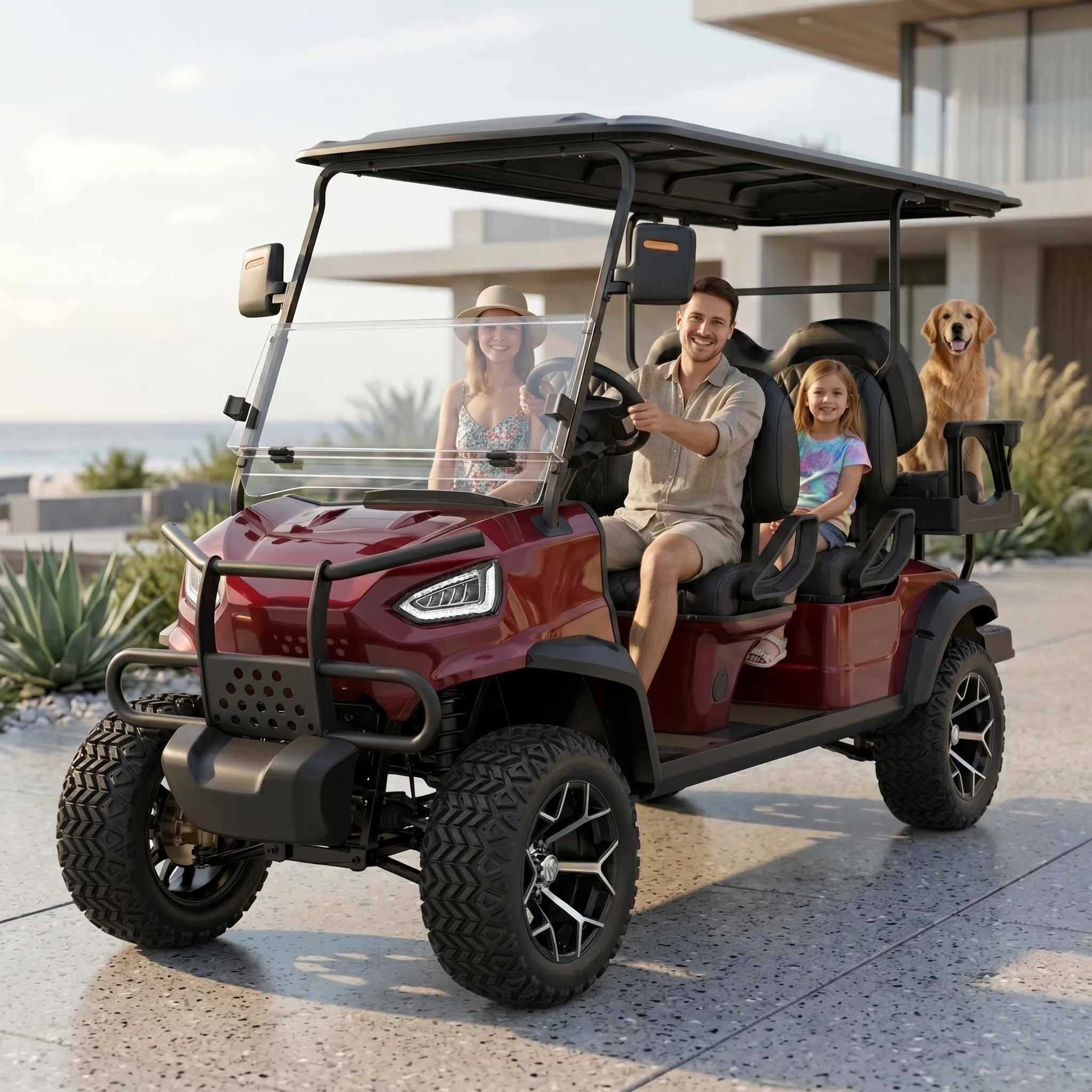
Buyers read “4-seater” as a compromise — fewer players, fewer trips. On this body it is the opposite. The layout is rated 3–4 seats depending on bench configuration, so each passenger gets a full-width seat, and two golf bags ride on the rear platform or in the well behind the second row. For a clubhouse-to-first-tee run, four players and their bags arrive in one trip.
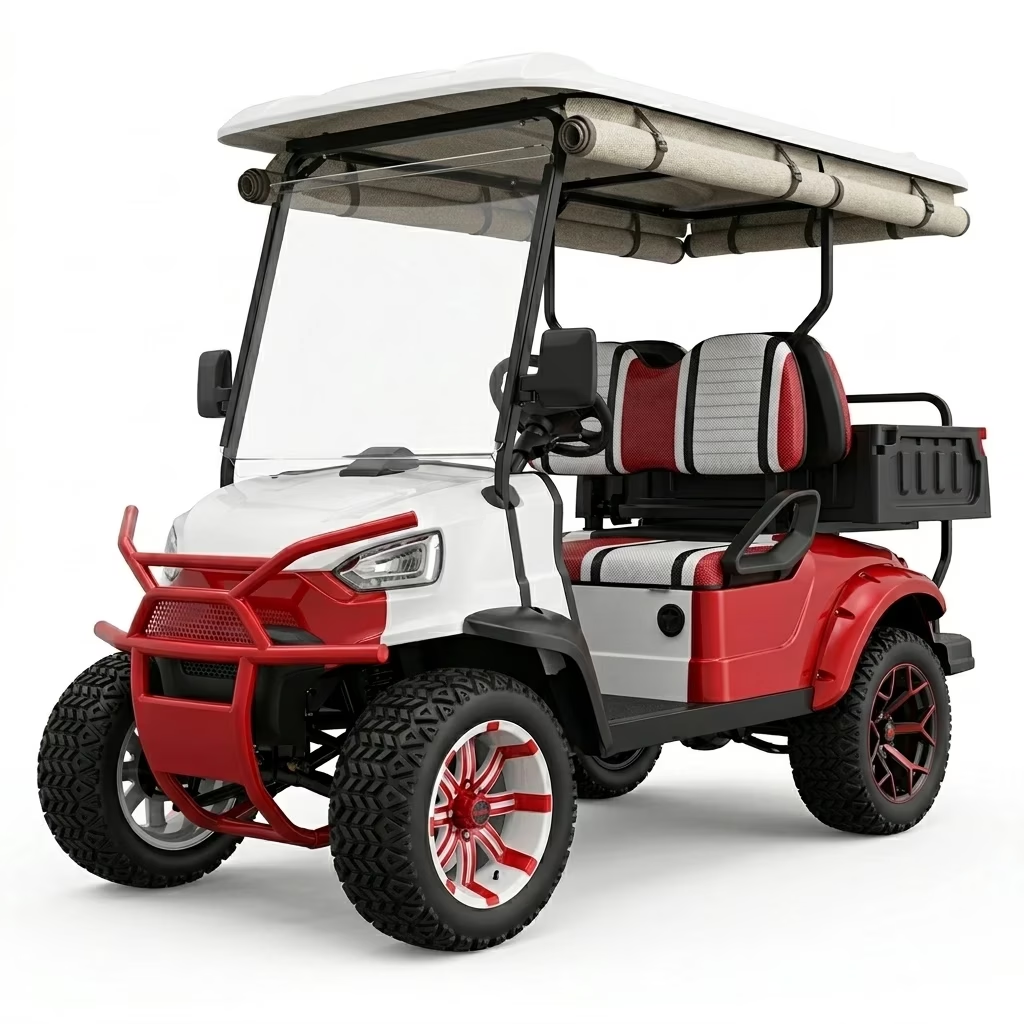
The body is white with a hardtop, black diamond-stitched leatherette seats, black wheel arches and LED headlights — it reads as a club vehicle, not a work cart. Where it beats a longer unit is manoeuvring: a 6-seat body on a narrow cart path becomes a reverse-and-correct on every lap. Where it does not fit is peak demand — on a tournament morning with a queue at the first tee, one 4-seater stops being enough. Size from peak concurrent demand, and compare body options in our golf cart range.
70–90 km Range in Real Use
The 70–90 km figure is a band, not a number. The low end and the high end are different battery configurations, and both assume a test condition: part load, moderate temperature, steady speed, new pack. Three things pull a cart towards the 70 km floor:
- Full load. Four players and their bags add mass to every acceleration and every rise in the fairway.
- Speed. 50 km/h rather than 30 km/h costs range quickly — drag rises with the square of speed and the pack is small.
- Heat and pack age. Sustained heat above 35°C cuts usable capacity, and a three-year-old lead-acid pack will not deliver its day-one figure.
Do the arithmetic on your own course: loop length × loops per day ÷ usable range, plus 30% margin. An 18-hole loop of 7 km run six times is 42 km — inside the 70 km floor on paper, and outside it in summer with four adults aboard and a hilly back nine.
Ground Clearance and Grade Ability: What 200–250 mm Buys You
200–250 mm of clearance is more than a turf-only cart carries, and it is there for the parts of a course that are not fairway: kerbs at the clubhouse, gravel and packed-earth service roads, drainage channels, lifted paving and wet rough. Below that band, carts catch their underside on exactly these surfaces, and that damage is rarely a warranty event.
The 20–25° grade is the other half: enough for tee-to-green access roads, ramps and short steep sections, measured with a load. Wet grass, loose gravel and four adults all reduce what is achievable, so work to 20° and treat 25° as best case. Tyres are 300-10 — a size that suits paved and packed surfaces; check local availability before ordering a fleet.
Charging, Battery and Daily Duty Cycle
A 7–9 hour charge is an overnight charge: one full day of play per cart, back on the charger at the end of it. A club running morning and afternoon tee slots needs either a second cart in rotation or a chemistry that tolerates opportunity charging — which depends on the battery type you specify.
The charger is the part buyers forget. Confirm voltage and frequency before production: 110V and 220–240V markets, on 50 or 60 Hz, need different chargers and plugs. A cart that arrives with the wrong charger sits in the shed.
A workable daily plan: measure your loop, count the rounds per day, and keep the total under about 70% of the range figure; the rest is reserve for hills, load and pack ageing.
Specification Summary
| Model | Urit 4 Seat Electric Golf Cart |
|---|---|
| Seats | 3–4 seats (bench configuration) |
| System voltage | 48V |
| Battery | Lead-acid or lithium — capacity by configuration |
| Range per charge | 70–90 km (battery configuration dependent) |
| Max speed | 30–50 km/h |
| Grade ability | 20–25° |
| Charge time | 7–9 h |
| Ground clearance | 200–250 mm |
| Curb weight | 300–400 kg |
| Brakes | Front drum + rear drum |
| Tyres | 300-10 |
| Loading quantity | 20GP and 40HQ figures confirmed per order, assembled or semi-knocked-down |
| Body and trim | White hardtop, black diamond-stitched leatherette seats, black wheel arches, LED headlights |
| Certification | CE certified — confirm which model the certificate covers |
| Origin | Beijing, China |
What to Confirm Before Ordering
- Battery type and capacity. Lead-acid or lithium decides cycle life, weight and whether opportunity charging is possible. Ask for Ah and cycle count in writing.
- Charger voltage, frequency and plug. Specify the destination market, not just the country. This is the most common error at shipping stage.
- Spare parts package. Controllers, chargers, brake shoes, one set of tyres and tubes, one key set per ten carts — confirm against your fleet size.
- Container loading quantity. Ask for 20GP and 40HQ figures, assembled and semi-knocked-down; the gap changes landed cost enough to affect pricing.
- CE certificate scope. Ask which exact model, body length and battery type the certificate covers; a document for a different configuration does not automatically cover yours.
If you need more capacity on the same route, the 6-seat electric cart is the next size up, and our team can size the fleet against your rounds per day and loop length.
Frequently Asked Questions
Can this golf cart be used on public roads?
That depends on your market and on whether the route uses a public road. On private property — golf clubs, resorts, estates, campuses — most jurisdictions treat this class of vehicle outside road-vehicle type approval. Where a route crosses a public road, registration and a vehicle category usually apply. Get a written position from your local authority first; this page makes no road-legality claim.
Does it carry golf bags as well as four players?
Yes, with the caveat that bag capacity depends on whether you specify the rear platform or the well behind the second row. Confirm the arrangement with the factory against your bag size — tour bags are longer than carry bags.
What warranty applies?
The frame carries 24 months; motor, controller and battery each carry 12 months. Consumables and damage from use outside the rated load are excluded; ask for the terms with the quotation.
How many units fit in a container?
It depends on the body option and on whether carts ship assembled or semi-knocked-down. We confirm both the 20GP and 40HQ figures against the exact configuration you order, with the quotation.

Reviews
There are no reviews yet.