
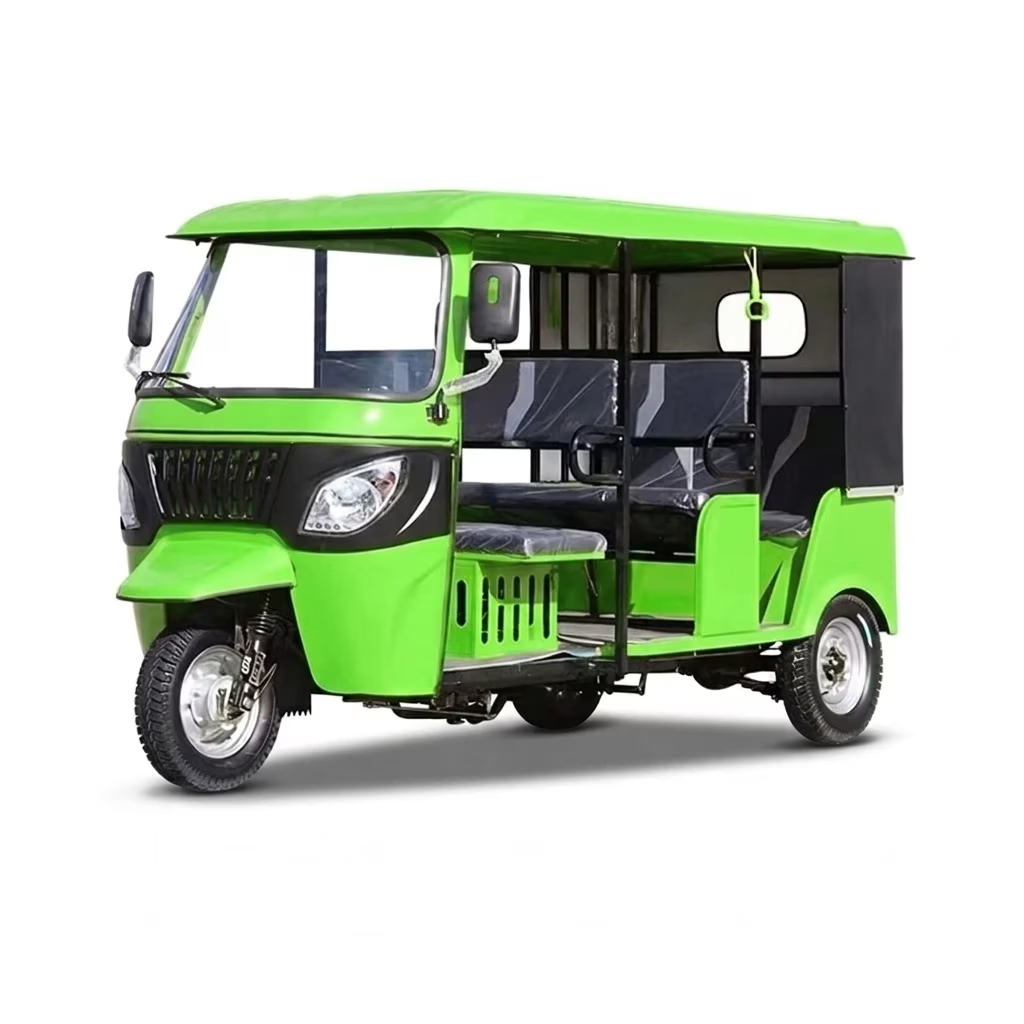
Most importers pick around 90% of the specification before they pick the body. Enclosed or open is usually the first question a new buyer asks, and the last one they settle properly. In all our Tuk Tuk exports this decision is almost never about price, and almost always about the same five things: closure cost, climate exposure, finished weight, passenger count, and which parts fail first. This guide works through all five so you can confirm the body before you confirm the order.
What the Body Changes and What It Doesn’t
The body is not a trim option. An open Tuk Tuk is a frame, a bench and a roof on a chassis; an enclosed one is a cabin with doors, glass, seals, wipers and a dashboard, on the same class of chassis. The difference shows up as weight, cost, service life and the number of parts that can break.
It does not change what the vehicle does. Both bodies carry passengers on the same route at the same speed. Open or enclosed is about how the vehicle behaves in weather, how often it needs repair, and how many passengers it can hold for a given size.
What the Enclosure Actually Costs
The gap between an open and an enclosed Tuk Tuk is not one number. It sits in a handful of parts, and it is worth pricing them separately because they fail separately.
| Item | Open body | Enclosed body | Why it matters |
|---|---|---|---|
| Doors and latches | None | 2–4 doors with latch sets | The most common wear item on a closed body |
| Glazing | Windscreen only | Windscreen, side glass, rear glass | Glass is the highest-cost single item in the enclosure |
| Seals and trim | Minimal | Door seals, window seals, gutters | First thing to fail in heat and dust |
| Wipers and washer | Optional | Fitted | Small part, high downtime when it stops |
| Dashboard and trim | Basic | Full cabin trim | Adds cost and one more thing to replace |
| Ventilation | Open air | Windows, vents, optional A/C | A/C increases cost and draws from the pack |
To compare quotes, ask for the two prices on the same chassis and the same battery, and add up the parts that differ. On typical six- to nine-seat bodies the enclosure usually adds a meaningful share of the unit price rather than a small premium, and the exact figure varies with glass type and door count, so it has to come from the quotation rather than from a catalogue.
Climate Decides This Faster Than Price
In practice the market picks the body. Three simple conditions sort most destinations into one answer.
| Condition | What it does to the body | Usual answer |
|---|---|---|
| Regular rain and high humidity | Water enters open cabins; seats and harnesses stay damp; electrical connectors corrode | Enclosed |
| Heavy dust, sand or road grit | Grit gets into open cabins and into the driver’s eyes and controls | Enclosed |
| Dry, mild climate and short trips | Weather rarely interrupts a route; passengers accept open air | Open |
| Mixed: long dry season, short wet season | Enclosed is used some months, open the rest | Semi-enclosed or a mixed fleet |
Two market signals are worth checking before you order. Ask whether local operators run open vehicles through the wet season, and ask what passengers expect for the fare. Where riders pay more, they expect shelter, and an open vehicle becomes harder to sell on.
Weight and Range: What the Cabin Costs in Energy
A closed body adds glass, doors, trim and seals, and that weight is carried for the whole route. On a small pack, added mass shows up as shorter range and slower climbing.
The relationship is not linear, and it is not the same on every route. On flat ground with light loads the penalty is small. On gradients and with a full passenger load it is larger, because the vehicle is working against weight the entire time. So a range figure quoted for an open body should not be carried across to the closed version without confirming it.
If the route includes a climb or a long continuous loop, ask for the range of the specific body you are buying, with passengers aboard. A figure tested on the open body is not a figure for the enclosed one.
Climate control adds a second draw on the pack. A/C and cabin heating are not free features; they take energy from the same battery that moves the vehicle. In hot markets this is often the single largest difference between the open and closed versions in daily use, and it needs to be part of the route arithmetic rather than an afterthought.
This guide avoids printing a specific weight or range figure for either body: those numbers change with the chassis, pack and door count, and a generic figure would mislead rather than help. Request the values for the exact configuration you are ordering.
Passenger Count Changes the Answer
An enclosed body usually carries fewer passengers than an open body on the same footprint, because the cabin structure takes space that would otherwise be seating. That is the trade: shelter costs seats.
Cost per passenger per kilometre is the honest way to compare them. Take the vehicle price, add the running cost over the expected service life, divide by passengers carried and by distance covered. An enclosed vehicle that carries two fewer passengers can still win if it extends the operating season or supports a higher fare, and it can lose badly if the route depends on peak volume.
The decision therefore starts with the route, not the body. Count the passengers at peak, not the average. If the peak is what pays for the vehicle, the open body usually wins. If the season is short and the fare is high, the enclosed body usually does.
The Parts That Fail First
On an enclosed Tuk Tuk the repair history is predictable, and it is worth knowing before you commit because it drives your spare parts order.
Door latches come first. They are used every trip, several times per trip, and they wear faster than anything else on the vehicle. Glass comes second, partly through impact and partly through mounting stress on rough roads. Wiper motors come third, especially where dust and grit shorten their life.
Seals and trims sit around these, and they are what makes a vehicle feel old before it is. In humid markets they also let water in, which then attacks connectors and seat frames.
An open body has the opposite profile: fewer closure parts, but more exposure to the same wear on seats, harnesses and connectors. Its costs are lower per incident but more frequent.
The Bucket Argument: What It Actually Saves
There is a strong case for the open body in the right place, and it is worth stating plainly. An open Tuk Tuk carries more passengers on the same footprint, costs less to buy, and has fewer closure parts to replace. In a dry, mild market running short urban trips, that is the better commercial answer, and a closed body would be money spent on shelter the passengers do not need.
Carriers in these markets pair an open body with a fixed route and short hops, keep a small spares kit, and accept that a wet day is a lost day. That works when wet days are rare and the fare is low.
The same argument fails in a humid or dusty market, where the lost days and the repair cycles add up faster than the price difference.
What to Confirm Before the Deposit
Whichever body you choose, these are the points to settle in writing before payment:
- Which body the quoted price covers, and which closure parts are included
- The exact passenger rating for that body, not for the model family
- Range figure for that body, with a stated load and test condition
- Whether A/C or heating is fitted, and what it does to range
- Spare parts list for the closure: latches, glass, seals, wiper motor
- Container loading for that body, in the packing method you are buying
- Which certificate covers that model, body length and battery
None of these is a negotiation point. They are the difference between a quote you can compare and a quote you have to guess at.
Frequently Asked Questions
Can an open Tuk Tuk be converted to enclosed later?
Not sensibly. The cabin is structural, not a bolt-on accessory, and adding it after delivery costs more than ordering it. Decide the body before you order.
Which body holds its value better?
The enclosed body usually does in wet or dusty markets, because the closure is what buyers check first on a used vehicle. In dry markets the difference is smaller.
Is a semi-enclosed body a real option?
Yes, and it is often the right compromise where rain is seasonal and the budget does not stretch to a full cabin. Confirm exactly which panels are fitted, because the term is used loosely.
Next Step
If you are still deciding between the two bodies, start from the route: how many passengers at peak, how long the loop is, and how many days a year weather stops operations. That usually settles it within a minute.
Two reference points on our own range: the 60V 2000W six-seat open Tuk Tuk for open-body work, and the enclosed nine-seat Tuk Tuk for markets where the cabin pays for itself. For the wider comparison of what a cargo tricycle does differently, see our cargo tricycle vs Tuk Tuk guide.
Regulation is set by your national authority, not by us. Confirm the classification and documentation your market requires before you place a deposit.
Send your route, the body you are considering and your destination port, and we will confirm the specification, the loading quantity and the price for that exact configuration rather than a generic figure.